
MACULAR DEGENERATION CARE
Macular degeneration care for your family’s vision
Many families in Northeastern Pennsylvania hear the words macular degeneration and feel stuck in watch-and-wait. We walk you through what’s happening in plain English — and, for the right dry AMD patients, we talk about an in-office light therapy option called Valeda (photobiomodulation).
What is age-related macular degeneration (AMD)?
Age-related macular degeneration (AMD) affects the macula — the part of the retina that supports sharp, central vision for reading, driving, and recognizing faces.
Early on, dry AMD often has few noticeable symptoms. That’s why routine comprehensive exams matter: our doctors can spot macular changes sooner and talk through options before small problems become big worries for your family.
Possible symptoms to mention at your visit include blurry or distorted central vision, trouble with fine detail, straight lines that look wavy, needing more light for close work, faded colors, or blank spots in central vision.
Dry AMD vs wet AMD — why the difference matters
Not all macular degeneration is the same, and that matters for care.
Dry AMD
Dry AMD is the more common form. It often develops slowly as the macula thins over time. Early stages may involve drusen (yellow deposits under the retina).
Wet AMD
Wet AMD is less common. It involves abnormal blood vessel growth and usually needs a different treatment path.
Valeda is discussed for selected dry AMD patients — not for wet AMD. If you’ve been told you have macular changes or dry AMD, ask us which path fits your eyes after a full evaluation.
Valeda light therapy (photobiomodulation) for dry AMD
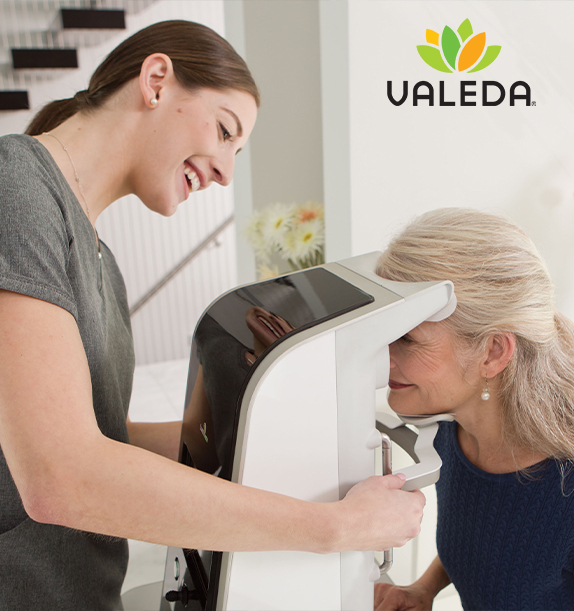
In plain English: carefully controlled light therapy for the back of the eye. The clinical name is photobiomodulation (PBM). The system we use is the Valeda Light Delivery System.
- Noninvasive — light only for this treatment; no needles and no surgery for Valeda itself.
- Done in the office; you’re awake.
- Our five NEPA offices can evaluate whether Valeda belongs in your plan after we look at your eyes.
Valeda is an FDA authorized (De Novo DEN230083) prescription light-based device intended to provide improved visual acuity in eligible patients with dry AMD who meet specific clinical criteria. Your doctor decides candidacy — not a webpage.
Who we evaluate for Valeda
We generally discuss Valeda for people with early to intermediate dry AMD who still have useful vision — after a comprehensive exam, imaging as needed, and a conversation about your goals.
Candidacy depends on findings in your eyes, including your vision and the appearance of the macula. We will not diagnose or clear you for treatment from this page alone.
If Valeda isn’t the right fit, we’ll still help with monitoring, lifestyle counseling, and the right referral path for wet AMD or more advanced disease when needed.
What a Valeda visit feels like
Wondering what a Valeda visit feels like?
- Short, comfortable office sessions using gentle colored light.
- Sessions are commonly described as taking under about five minutes per eye, with brief phases of yellow and near-infrared light (eyes open) and soft red light (eyes closed).
- Many patients find it comfortable, and there’s typically no downtime described for returning to your day.
- A common plan is a series of visits over a few weeks, with follow-up series discussed on a schedule your doctor personalizes.
We’ll explain your plan before you start — including how many visits and how we follow progress.
Nutrition and supplements
What you eat can be part of the conversation when we talk about macular degeneration. A diet that includes leafy greens, colorful vegetables, and fish is often discussed as a way to support overall eye health.
Your doctor may also talk with you about an AREDS2-style eye vitamin — a supplement formula used for some people with dry AMD. These supplements are not right for everyone, they are not a cure, and they are not a substitute for an exam or for other care.
Please don’t start a new supplement on your own from this page. We’ll discuss whether an AREDS2-style vitamin, and what you eat, belong in your plan.
Care close to home
Care close to home — the same family of practices, with local teams who know NEPA. Book an exam and ask about Valeda at your visit.
A free community education evening
Join us for a free AMD community education evening on Tuesday, December 15, 2026, from 6:00 to 8:00 p.m. (America/New_York) at The Colonnade in Scranton.
Guest speakers will be Dr. James Deom, Dr. Thomas P. Kislan, and Dr. Ajey Alurkar, a retina specialist. We’ll share plain-English teaching on macular degeneration and care options families ask about, including when light therapy may be discussed.
This event is free.
Or call your office to reserve a seat.
Questions families often ask
Is Valeda a cure for macular degeneration?
No. Valeda is an option we may discuss for selected patients with dry AMD. It is not a cure, it is not for wet AMD, and it is not right for everyone. Your doctor will explain whether it belongs in your plan.
Is Valeda FDA approved?
Valeda is FDA authorized (De Novo DEN230083) as a prescription light-based device intended to provide improved visual acuity in eligible patients with dry AMD who meet specific clinical criteria. Authorization is the accurate wording we use here.
Can I book a Valeda visit online?
Online booking is for an exam. Ask about Valeda at your visit, or call your office and we’ll help you take the next step.
What if I’ve been told I have wet AMD?
Valeda is not discussed for wet AMD. Please come in — or ask us to review your records — so we can help with the right path and referrals when needed.
How do I attend the December 15 seminar?
The evening is free and will be held at The Colonnade in Scranton, from 6:00 to 8:00 p.m. You can RSVP online, or call your office to reserve a seat.
Ready to talk about macular degeneration?
Book an exam at any of our five offices, or call us with questions.